
Hotel with US and Spanish investment demolished with explosives in Playa del Carmen for violating federal law against beach privatization
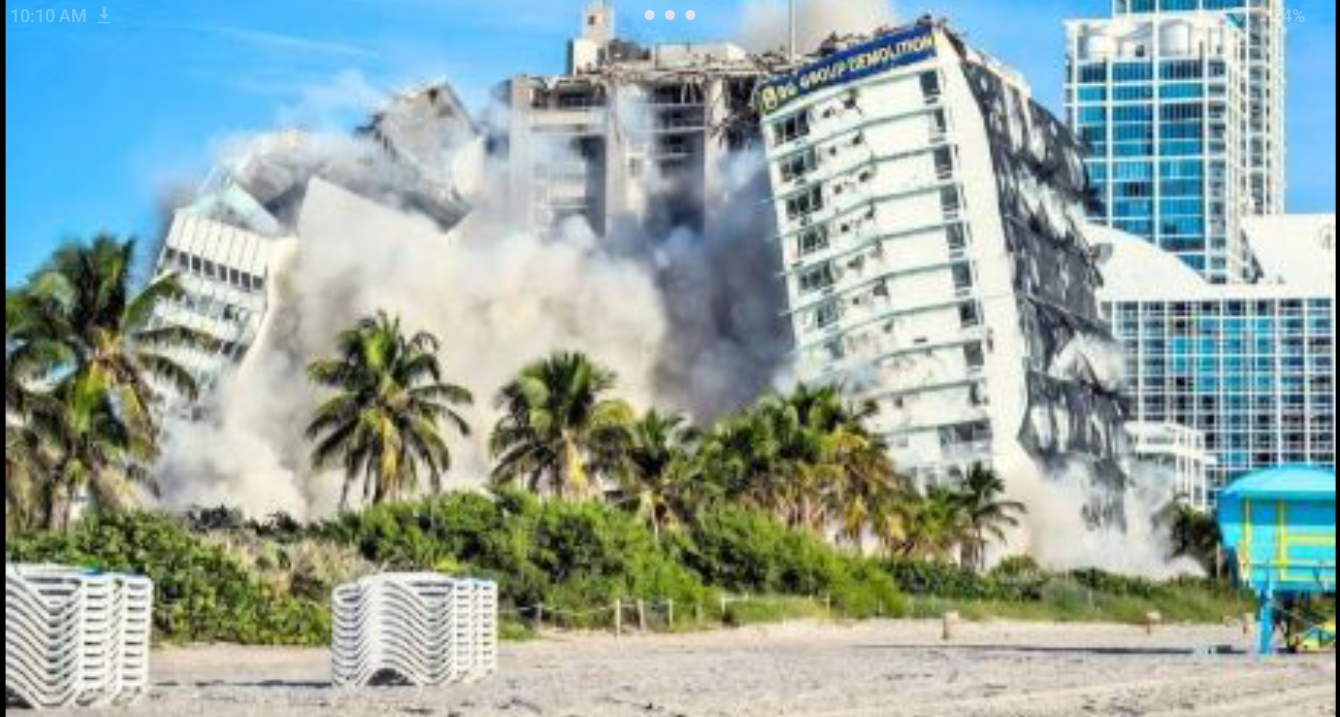 Playa del Carmen, Quintana Roo – A video that went viral on social media showed the exact moment a controlled implosion reduced to rubble the under-construction structure of the hotel and beach club “The Carmen”, located at the height of 8th Street in Playa del Carmen. What thousands of people shared and celebrated on the internet was not just the demolition of a building, but the enforcement of federal law against beach privatization in Mexico.
The project, which belonged to American investors and was being built by the Spanish group Gihoteles, had been denounced for weeks by Mexican citizens, local business owners, and activists through social media. The complaint was serious: even though the hotel was not yet finished, physical barriers had already been installed and the federal beach zone had been cordoned off, preventing free access and behaving as if the coast were private property from the construction stage. Neighborhood residents documented how construction machinery had removed part of the coastal dune and filled protected areas with sand, causing irreversible ecological damage.
Complaints filed with municipal authorities were ignored time and again. Citizens posted photos and videos on Facebook, Twitter, and Instagram showing the blockade and destruction of native vegetation, but no local authority responded. Frustration grew as they watched a foreign construction company arrive, fence off the beach, and begin building as if the Mexican coastline were its own.
It was then that the case came to the attention of the Federal Government through the viral spread of complaints on social media. The agency responsible for acting in these cases is the Federal Attorney’s Office for Environmental Protection (PROFEPA), under the Secretariat of Environment and Natural Resources (SEMARNAT), which has the legal authority to inspect, sanction, and order the demolition of works that violate legislation in federal zones.
PROFEPA initiated an ex-officio investigation and what federal authorities discovered was a double irregularity: on one hand, the project flagrantly violated the General Law of National Assets, which in articles 119 and 154 prohibits any type of beach privatization, considered under Article 27 of the Constitution as assets of the nation’s public domain. On the other hand, it was found that the construction operated with allegedly irregular permits granted by municipal authorities of Solidaridad, the municipality to which Playa del Carmen belongs, which explained why citizen complaints had fallen on deaf ears for so long.
The construction company Gihoteles, with Spanish capital, had begun work with the promise of a luxury development that would include exclusive areas for guests, but without respecting federal setback requirements or guaranteeing public access to the beach. The original plans, leaked by activists on social media, showed that the project intended to occupy a strip of the federal maritime-terrestrial zone that by law must remain free and open to the public.
The order from the Federation, through PROFEPA, was clear and unequivocal: total demolition of all structures that invaded the federal maritime-terrestrial zone. To guarantee the effectiveness of the operation and minimize risks given the magnitude of the construction, a controlled demolition with explosives was chosen, a method that allows buildings to be brought down precisely and in a matter of seconds. The material execution was carried out by municipal authorities, headed by Mayor Estefanía Mercado of the Morena party, who personally went to the site to supervise the work. This gesture was interpreted as adherence to the line set by the Federal Government and an attempt to distance herself from previous administrations or officials who may have facilitated the irregular permits.
The implosion left nothing standing. In a matter of seconds, the multi-level structure that was being built illegally on the federal zone became a mountain of rubble. Removal work began immediately afterward, with the objective of restoring the beach to its original state and guaranteeing free access for all citizens. Although the hotel was under construction and not yet operating, the perimeter barriers and construction machinery had already de facto privatized the space, preventing beachgoers from passing through.
National operation: permit review and massive closures
The demolition of “The Carmen” is not an isolated case, but part of a much broader federal strategy to recover Mexican coastlines. At the end of October 2025, PROFEPA carried out a coordinated inspection operation in 14 coastal states, including Quintana Roo, Baja California, Guerrero, Oaxaca, and Yucatán. The result was overwhelming: 31 total or partial closures of real estate projects that operated without environmental authorization and that invaded the Federal Maritime-Terrestrial Zone (Zofemat), damaging protected ecosystems such as coastal dunes, mangroves, and wetlands.
This operation had the support of the Secretariat of the Navy (SEMAR), the National Guard, and the National Commission of Natural Protected Areas (CONANP), demonstrating federal coordination to enforce the law.
Federal authorities have recognized that there is a structural problem: in many cases, municipal governments grant construction permits in the federal zone without the prior environmental impact authorization issued by SEMARNAT, which constitutes a violation of the law. For this reason, President Claudia Sheinbaum has ordered an exhaustive review of all permits granted in recent years in coastal municipalities, to detect and cancel any irregular concessions that have illegally privatized access to beaches.
The federal position is clear: both developers who build illegally and the municipal officials who facilitated these irregularities will be investigated and sanctioned. As a PROFEPA delegate stated, “citizens must be vigilant that tourism development takes place within the environmental regulatory framework and above all with respect for our ecosystems.”
Responsibilities and sanctions
Those responsible for the “The Carmen” project, including the American investors who owned the property and the Spanish construction company Gihoteles, now face multi-million dollar fines and possible additional legal actions for the environmental damage caused to the coastal dune and native vegetation. The international capital structure of the business was no obstacle to Mexican law being applied in all its rigor.
The right of Mexicans to their beaches
This case has placed at the center of national debate a problem that affects the entire Mexican coastline. In recent years, the excessive construction of hotels, real estate developments, and beach clubs has progressively monopolized the coasts, converting spaces that belong to all Mexicans into exclusive areas for foreign tourists and people with high purchasing power. The citizen demand is clear: that the Federal Government continue these actions throughout the country, that all permits be reviewed, irregular ones canceled, and complicit officials sanctioned.
The video of the implosion of “The Carmen” went viral not only for the shocking images of the building collapsing in seconds, but for what it represents: the affirmation that in Mexico, laws are complied with and enforced, regardless of the origin of the capital. The beaches belong to Mexico, not to a handful of foreign investors, and the right of citizens to enjoy them is above any private interest.
Related Posts
-
 A milirary General arrested in connection with the disappearances of 43 students in Ayotzinapa Case
-
 Special Report Uncovers Secret Mexican Organization With Spanish Ties Illegally Training Underage Teens
-
 THE U.N. IS AN EMPORIUM MALL OF BUYERS AND SELLERS: AMLO
-
 ‘Who is who in fake news’, a New Segment in AMLO’s Morning Press Conference
About The Author

